The ledger, actually open
TL;DR: Bala Kamallakharan’s most recent article is rhetorical nonsense that’s riddled with internal contradictions, and structured in a way that looks like it’s steelmanning the “Yes” argument, but is actually playing a nasty little game by having the arguments for yes have wrong numbers, and the arguments for no having inscrutible adjectives. Almost everything in it is wrong in some way, often even contradicting the sources it claims to cite.
Godsdamnit, I didn’t want to have to respond to Bala’s rants. I like what Bala Kamallakharan does and represents, I like what he has done for Iceland in terms of building up, deepening and strengthening the Startup community. I even like some of his takes, and while he often takes a stance I don’t agree with, I can normally at least respect where he’s coming from. But his recent essays about why he’s voting “No” have been a parade of errors, and the most recent is the worst of the lot. So here goes.
(Bala: When you inevitably read this, please take it as the fair criticism it’s intended as, rather than a personal attack. Nothing here is intended as such.)
So, Bala’s most recent post over at Startup Iceland is The Best Case for Yes – and Why I Still Vote No. It is one more in a long line of seemingly AI-generated posts from him which race to confirm his biases without any actual evidence. In some structural sense, it’s one of the most honest-looking articles I’ve seen from the “No” the campaign: steelman the other side, then explain why you still disagree. That’s how it’s supposed to work. I wish more people did it.
Except, when I actually read the piece, I got progressively more annoyed, and now it’s Monday evening and I’ve spent a chunk of the afternoon pulling time series off Hagstofa and FRED instead of doing anything useful. (Nerd alert: I used FRED, the St. Louis Federal Reserve’s Data portal, because their UI sucks less than the OECD’s. What a world…)
So here we are.
Let me get one thing out of the way first, because it explains a lot. The piece reads like it was generated by an AI. The perfectly symmetrical five-points-for and six-points-against; the “not a caricature, but the real thing”; the “This is real, and I will not minimise it”; the tricolon that lands the closing paragraph. I don’t know how it was written – although it has all the hallmarks of AI – and I’m not especially interested in litigating it. What I care about is the failure mode, because it’s a very specific one and it’s all over this piece: the essay is rhetorically balanced and evidentially empty. Balance is a property of a text. Evidence is a property of the world. If you optimise for the former while ignoring the latter, you get something that reads scrupulously fair and checks out approximately nowhere.
Nearly every number in it that I could check was wrong, cherry-picked, or a category error. So let’s go through them one at a time.
First: what we are actually voting on
The question on the ballot on 29 August is: “Should negotiations on Iceland’s membership in the European Union start again?"
That’s it. That’s the question. It is not “should Iceland join the European Union.” A Yes reopens the accession talks that were suspended in 2013. If those talks produce a treaty, that treaty goes to a second referendum. Nobody is being asked to surrender anything on 29 August. Nobody is being asked to abolish the central bank, or hand over the fishing grounds, or adopt the euro. Sure, the EU’s stance is that Euro membership is not negotiable for new members, but negotiating positions are always framed in absolutes. We won’t know until we try. Plus, as I’ll explain – joining the Euro is explicitly a good thing to do.
The problem here is that Bala, like many in the “No” camp, is disingenously pretending that the referendum is about something it isn’t. It’s an infuriating rhetorical tactic, because it seeks to deliberately misinform people about what is going on.
But it’s actually worse than that. Bala’s essay is a detailed valuation of an accession treaty that does not exist. The fisheries terms declared unacceptable are terms that nobody has been offered. The “price of admission” is a price nobody has quoted. The entire piece prices a deal, finds the price too high, and votes against finding out what the price is.
I want to be fair here, because there is a coherent version of this position: “negotiating creates momentum, and momentum is itself a commitment, so refuse at step one.” Essentially, that we are very prone to subject ourselves to a sunk cost fallacy. That’s a real argument, but it is not the argument that Bala is making. The argument being made is an itemised cost-benefit analysis of a contract that has not been drafted. It’s not caution, it’s fiction.
Right. Now the numbers.
“The euro’s efficiency gain is a modest, recurring saving”
The claim is that the euro would lower Iceland’s cost of capital by 25 to 100 basis points, sourced to “the government’s own report,” without saying which report specifically it is he’s citing.
I can only assume he’s referring to the report the Ministry of Finance published in May 2026 detailing the findings of its commissioned expert review of Iceland’s currency arrangements. The headline was that the costs of maintaining the króna significantly outweigh the benefits. The report ties the króna directly to persistently high inflation, elevated interest rates, and cyclical instability, and it found that the exchange rate “does not promote economic stability, except during major shocks,” and that exchange-rate movements have amplified rather than mitigated the effects of economic shocks.
So: the report is cited for its most conservative sub-estimate of one detail, and its actual verdict is not mentioned. Here Bala isn’t weighing evidence, he’s cherry picking.
But set that aside and take the 25-100 bp figure on its own terms. Is it plausible? We can just look.
(I should mention that I asked an AI to generate these graphs for me from the data, but I verified them against the source data before publishing this; I have source references at the bottom of the post)
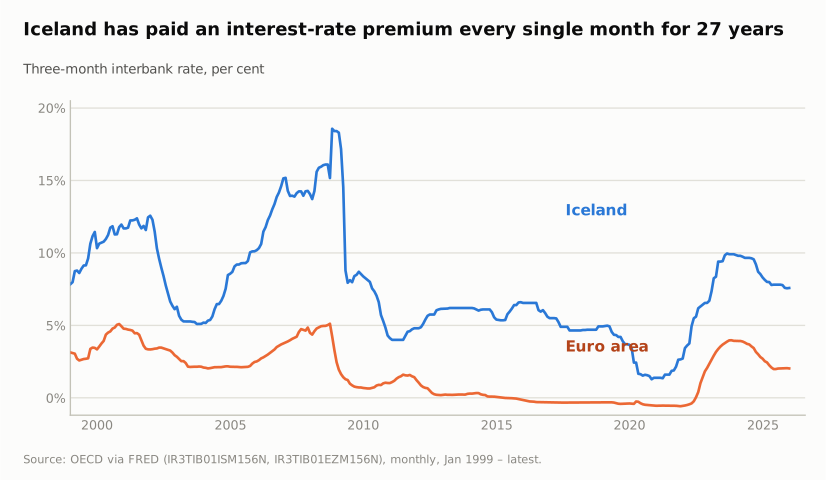
That’s the three-month interbank rate in Iceland and in the euro area, monthly, from the launch of the euro to now. The blue line is not sometimes above the red line. It is always above the red line.
Here’s the gap on its own:
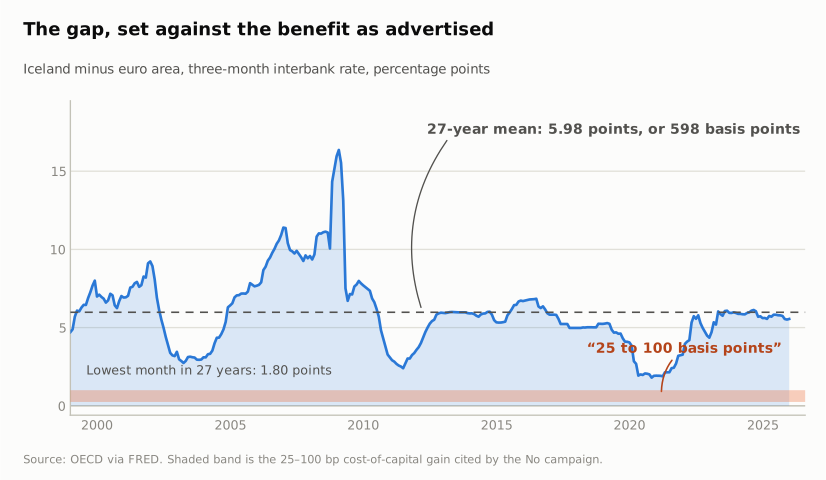
The mean spread over 325 months is 5.98 percentage points – 598 basis points. The narrowest it has ever been, in the best single month of twenty-seven years, was 1.80 points. It has never once been inside the 25-100 bp range that the essay treats as the whole of the prize. Not one month out of 325.
A nominal rate gap isn’t a pure risk premium. Most of it is the Fisher effect – nominal rates are higher because inflation is higher. Fine. Let’s strip inflation out entirely and compare ex-post real rates, nominal minus contemporaneous year-on-year CPI, for both:
| Period | Iceland real 3m | Euro area real 3m | Difference |
|---|---|---|---|
| 1999-2026 | 2.79% | -0.44% | 3.23 points |
| 1999-2007 | 5.35% | 1.11% | 4.24 points |
| 2011-2026 | 1.57% | -1.55% | 3.12 points |
| 2015-2026 | 1.51% | -1.69% | 3.21 points |
So even after handing over the entire inflation differential for free as an entirely artificial concession to a bullshit argument, the real cost of capital in Iceland runs about 323 basis points above the euro area, and has done consistently for a quarter of a century. That is three to thirteen times the number in Bala’s essay, depending on how cynical you want to be.
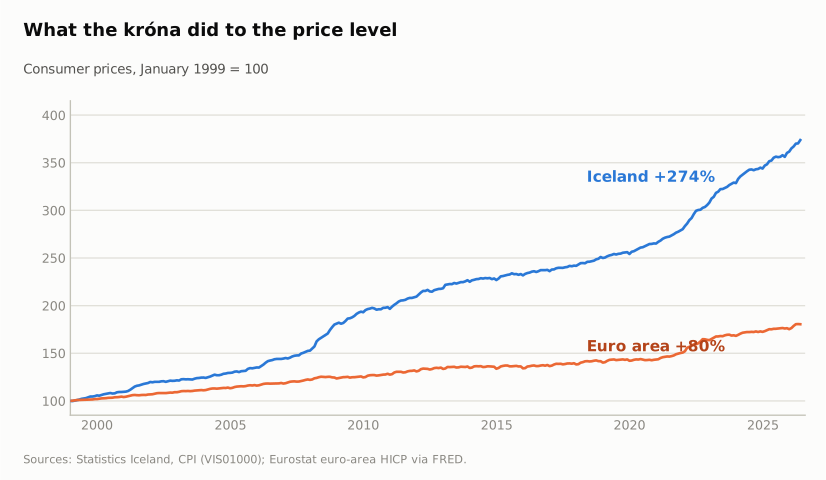
Since January 1999, Icelandic consumer prices have risen 274%. Euro-area prices have risen 80% in the same time. In the same world, with the same macroeconomic shocks.
The entire case for a small independent currency is that it absorbs asymmetric shocks – things that hit you and not your neighbours. Fine. We’ve suffered through decades of that argument being used as the golden counterexample against any changes to Icelandic monetary policy, despite the well known fact that the Icelandic króna is one of the smallest currencies in the world that is floating. Essentially, every other country that has a free floating or floating exchange rate regime is either much bigger or much poorer than Iceland. The only smaller currencies belong to Seychelles, Suriname, Liberia (heavily dollarized in practice), Somalia (nominally floating, but the shilling barely functions as a currency; most transactions are USD or mobile money), Madagascar, Moldova and Mauritius. Great company we are in, economically speaking. All other smaller currencies, and a great many much bigger ones, have some kind of managed exchange rate mechanism or a peg of some kind.
(As an aside: back when I was in Alþingi, I used to have a poster on my office wall that I made out of the IMF’s version of the exchange rate regime table in that Wikipedia link. Not just because I’m a nerd, but because it’s absolutely critical to understanding why Iceland’s economy is a perennial basket case.)
So look at 2021-2026, the largest common shock in forty years, an series of inflation waves that hit everybody at the same time for the same reasons – a Streetfighter style combo of COVID, Russia’s invasion of Ukraine, global shipping disruption, Trump’s mercantilist agenda, and most recently the Hormuz crisis. Iceland: +41.0%. Euro area: +25.9%. So on the type of shock where the currency’s supposed advantage was definitionally irrelevant, the currency made things fifteen points worse. Which is exactly what the government’s report said it does: amplifies rather than mitigates the swings.
“The one tool that let Iceland swing to balance within two years”
Bala’s case for “No” is heavily based on the notion of current accounts as a shock absorber, so let’s look at what the tool actually did. Yes, Iceland’s current account swung from a deficit of about a quarter of GDP to balance in roughly two years, and yes, that was faster than the euro periphery managed through internal devaluation. Both true. The essay presents this as the shock absorber doing its job.
Here is the shock absorber doing its job:
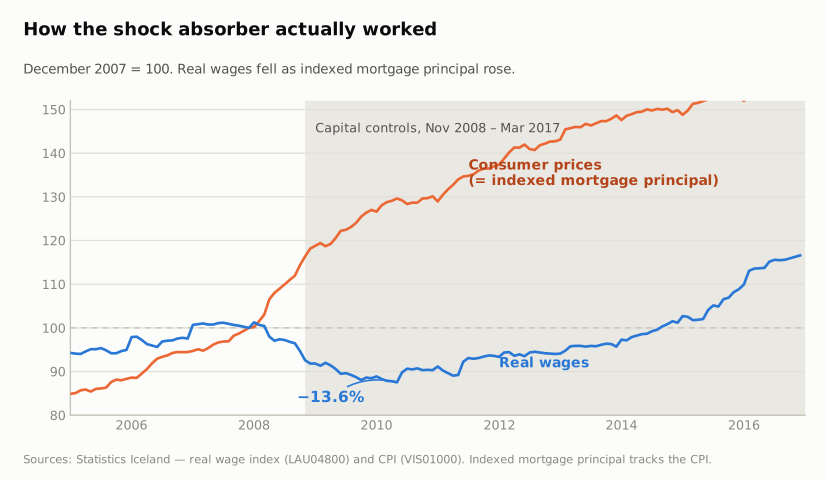
The real wage index – Statistics Iceland’s wage index at constant prices, table LAU04800 – fell 13.6% from its January 2008 peak to its May 2010 trough. It did not climb back to the 2008 level until November 2014. Nearly seven years.
Meanwhile the consumer price index rose 30.1% between December 2007 and December 2010. And because most Icelandic mortgages are index linked (verðtrygging), with the outstanding principal rising with the CPI – that 30% went straight onto the amount people owed on their houses.
So the mechanism was: cut everyone’s real wages by an eighth, and inflate the principal of their mortgages by a third. That’s using the poor and middle classes as a shock absorber. It’s more like a shock redistributor, and the direction it redistributes in is from wage-earners and debtors to exporters and creditors. The reason it worked faster than internal devaluation in Greece or Ireland is not that it was gentler. It’s that internal devaluation requires someone to agree to it and a currency devaluation doesn’t. Speed was purchased with consent.
And then there’s the bit the essay doesn’t mention. Iceland imposed capital controls on 28 November 2008 and did not remove them until 14 March 2017 – over eight years during which Icelanders were not permitted to move their own money out of their own country without special permission. That’s the grey band on the chart. In an essay whose entire closing argument is that independence, latitude and sovereignty are worth more than any price that can be written down, it seems worth mentioning that the last time we used the tool being defended, the price was the very financial independence of most of the people in the country for most of a decade.
One more thing on this. Bala lists indexation as a structural distortion that the euro would leave untouched and treats this as decisive against the credibility argument: “Indexation stays. The banking oligopoly stays.”
Verðtrygging was introduced by the Ólafslög in 1979 (yes I’m citing Jacky Mallett’s paper twice, because you should read it), after a decade in which Icelandic inflation ran 25-50% a year and peaked above 80%. At those rates a twenty-five-year nominal mortgage is meaningless, so the state indexed everything. Indexation is not a mysterious domestic pathology sitting alongside the currency question. It is a prosthetic for a currency that could not hold its value. It exists downstream of the króna. Arguing that we should keep the króna because the euro wouldn’t abolish indexation is like refusing surgery on the grounds that it won’t remove the splint.
“The capital depth is real but buildable at home”
Look. Iceland does not have a capital shortage. Icelandic pension fund assets are close to 200% of GDP. They are larger than the banking system and the insurance sector combined. They are, as the Central Bank has noted, more than sufficient to buy every listed equity, bond and bill in the country. Twenty-one funds, of which the top three hold about half the assets. Nasdaq Iceland is 28 companies and roughly €17 billion.
The domestic savings pool is large enough to swallow the entire domestic investable universe whole. There is nothing left to build. You cannot fix that by building more of it, because the binding constraint was never the quantity of money – it’s the number of counterparties, and the number of counterparties is bounded by the size of the country. 400000 people can only do so much. Depth is not a pile of capital. Depth is having someone to trade with who isn’t your cousin.
You can watch the constraint bind in real time. Marel listed on Euronext Amsterdam, in its own words, to strengthen its capital structure and “access international capital markets.” Alvotech and Oculis (which Bala invested in, if I recall correctly!) went to Nasdaq in New York. Kerecis was sold to Coloplast of Denmark for $1.3 billion. Iceland is third in the world in unicorns per capita, and it exports them, because the capital is somewhere else and always has been.
Even the pension funds themselves demonstrate the point. They target 3.5% real returns – a number that has to come from somewhere, and it cannot durably come from a 400,000-person economy – so the 2022 reform lets them move up to 65% of assets abroad. Which means taking currency risk. Which brings us back to the króna. The system’s own plumbing routes around the domestic capital market, because the domestic capital market is too small, because the country is too small, and no amount of patient institution-building changes the population.
On the flip side: I’ve talked with dozens of VC funds that have zero interest in investing their money in Iceland, because the market is too small, too weird, and too flimsy to feel secure. Whether it’s the politics or the blessed Króna, the outside world largely stays away.
The IMF recommendation Bala’s essay leans on – deepen the FX and derivatives market – is real, and it’s good advice, and it does not do what the essay needs it to do. A deeper FX derivatives market gives you better hedging. Hedging is a cost, not a source of capital. That cost is precisely the transaction friction dismissed a few paragraphs earlier as modest.
And then there is the profound contradiction at the heart of the argument: Iceland has had forty-seven years to fix indexation and hasn’t, because it can’t, because indexation is a terrible mechanism. This is offered as proof that the domestic political system is structurally incapable of reform. Two paragraphs later, we’re told that fifteen years of patiently building a domestic capital market with the levers in our own hands beats getting the depth immediately. Come on. Iceland has had thirty-two years since the EEA and nine since the capital controls came off. Either we can do hard institutional work at home or we can’t. You don’t get to invoke Icelandic incapacity when it kills the argument you dislike and Icelandic capability when it saves the one you like.
“The seat is real but tiny”
Then Bala goes on to make a representation weighting error:
it is roughly 0.08% of the vote, in exchange for 100% of the national control Iceland now holds
0.08% is Iceland’s share of the EU’s population. 394,324 people out of about ~450 million. It is not Iceland’s weight in any European institution, and it never has been. It is a demographic ratio being passed off as a voting weight.
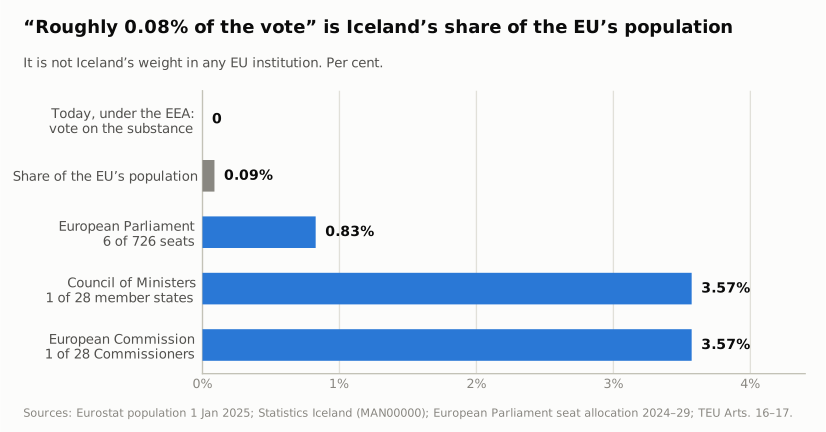
The actual numbers: six seats in a 726-seat Parliament is 0.83%, ten times the quoted figure. One Commissioner of 28 is 3.57%. In the Council, qualified majority requires 55% of member states and 65% of population – Iceland is one of 28 states on the first leg, and a blocking minority requires only four states. And in practice about 80% of Council decisions are taken by consensus anyway, which is a system where the ability to be in the room and say “not like that” is worth considerably more than your population share.
Meanwhile, degressive proportionality means small states are deliberately over-weighted. If Iceland joined:
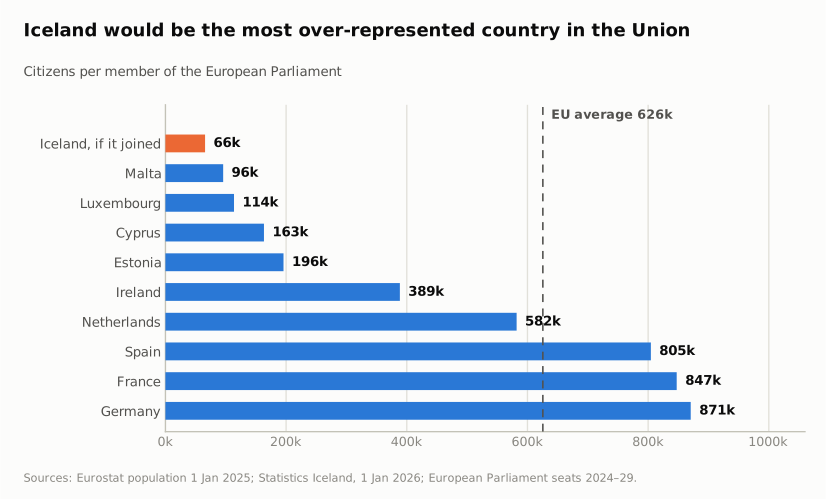
One Icelandic MEP would represent about 66,000 people. One German MEP represents about 871,000. An Icelandic vote in the European Parliament would be worth 13 times a German vote, and Iceland would be the most over-represented citizenry in the Union – even more so than Malta.
But the seat count isn’t even the real error. The real error is the denominator. “100% of the national control Iceland now holds” – no. That is not the status quo, and Bala knows it isn’t, because three paragraphs earlier he says so:
Critics call it “fax democracy,” and they are right.
Right. So which is it? Either Iceland currently takes rules it has no vote on, in which case the status quo is not 100% control; or the status quo is 100% control, in which case fax democracy isn’t real. Both claims are in the same essay, four paragraphs apart, and the argument requires both.
For what the counterfactual actually looks like in detail, there’s Sæti við borðið. It walks a single real piece of legislation, the emissions trading system, through all fourteen steps from “negotiating aims are set” to “the national parliament takes over,” and asks at each step what a small member state can do and what Iceland can do. (Bias: I helped Ásta a little bit with getting that project launched. It’s still really good.)
The answer is that a member state has a seat with decision-making power at ten of the eleven stages where the substance of the law is decided. Iceland has one at none of them. Iceland’s first real seat comes at step 13, the EEA Joint Committee, and it is a seat on incorporation, not substance – you can decline to take the law, but you cannot reopen the political compromise that twenty-seven other countries already made without you. Step 14 is Alþingi, which encounters the thing almost for the first time and implements it.
That’s not hypothetical, either. When the EU’s “Fit for 55” package extended the ETS to aviation in 2021, Iceland made a very firm case about the particular position of Icelandic air links – geography, economic impact, the lot – at EEA Council meetings. It got nowhere, for the simple reason that the deal had been struck. Iceland wasn’t at the table. How do I know this? I was there. At the time it was going through (a bit earlier in the process – up until ~October 2021), I was the chairman of Iceland’s parliamentary delegation to EFTA and the EEA, and sat on the EU-Iceland Parliamentary Committee. I saw in this case and many others how being late to the table – and having not had a seat at it earlier – led to us achieving exactly nothing.
So, the trade on offer isn’t 0.08% versus 100%. It’s decision-making power at ten of eleven stages versus zero, on a body of law – more than 9500 acts incorporated into the EEA Agreement, around 5,000 currently in force – that Iceland implements either way. Calling that “a change in the form of sovereignty, and a reduction in its substance” requires believing that having no vote on rules that bind you is the more sovereign condition.
Seriously, the “no” crowd really need to start being more realistic about what the actual implications of being a net recipient of laws means for us. I will happily defend the EEA agreement as being the single most important international treaty Iceland is party to, and I did so as a large part of my work in the Icelandic parliament for five years. But we ignore the downsides of it at our peril, and the downsides become more pronounced the more the EU becomes integrated, because Iceland (and the other EEA-EFTA states) will increasingly be limited to having to accept the EU’s preferred approach on things.
The fisheries, honestly?
Bala’s supposedly strongest argument (“the crux”) is that by joining we would be “surrendering authority over the resource the modern Icelandic state was built on”. Sigh.
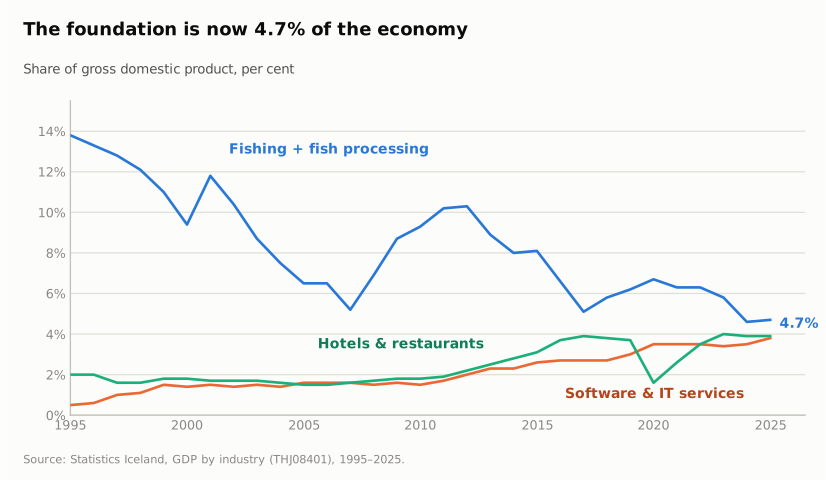
Fishing and fish processing together are 4.7% of GDP in 2025, down from 13.8% in 1995. Yeah, I know, I was surprised too when I saw that. Fishing on its own is 2.8% – smaller than hotels and restaurants (3.9%), and smaller than software and IT services (3.8%). Iceland has gone from a heavily fisheries dominated economy in the early 1990’s to having fisheries as a small and culturally important sector, and one with a lot of export value, but nowhere near as important as it used to be.
So yeah, fisheries are a much larger share of goods exports than of GDP, they’re geographically concentrated in communities where they are effectively the entire economy, and “the resource the modern Icelandic state was built on” is a statement about political history, Icelandic culture and identity, that a GDP share doesn’t refute. All true. I’m not arguing the fishing industry is unimportant. I grew up in Vestmannaeyjar, ffs, I know how critical it is.
Instead, I’m arguing about the weighting. The essay’s position is that the regulatory autonomy of a sector that is 2.8% of GDP – on terms that have not been negotiated, under a Common Fisheries Policy whose relative-stability principle allocates quota on the basis of historical catch – outweighs a 320-basis-point real cost of capital applied to the entire economy, forever, and that none of the changes in the structure of the Icelandic economy that have happened largely in the period since Bala moved to Iceland have any impact on that.
And seriously, it’s the founder of Startup Iceland making that trade. Look at the chart again. The blue line is falling and the red line is rising and they have already crossed. The sector being protected is now smaller than the sector doing the protecting, and the protection is being paid for out of the cost of capital of the sector doing the protecting.
The reality is, Icelandic fisheries are culturally, and historically important in Iceland, but they are not at risk by joining the EU. This is known, because looking at the details (as many have, ad nauseam), leads people to understand that the only fish stocks that would fall under the Common Fisheries Policy are those that are already shared with the EU through detailed agreements, and those that aren’t will continue not to be. However, the owners of the fisheries companies, who amount to about ten families with extraordinarily outsized political and economic power given they represent (checks notes) ~4.7% of the economy, stand to lose a lot by Iceland being part of a political union where eliminating market manipulation, political corruption and systemic abuses is a perennial mission.
My question is, why is Bala protecting them?
The Draghi manoeuvre
The AI section deserves a short note. The argument is: the EU can’t help Iceland at the frontier, and the proof is the EU’s own competitiveness diagnosis – 8 billion USD of AI investment against America’s 68 billion, three large foundation models against America’s forty. This is based on the Draghi report.
The Draghi report’s recommendations are: complete the Capital Markets Union, build the Savings and Investment Union, issue joint European debt to create a deep and liquid market, and mobilise €750-800 billion a year in additional investment. Its central diagnosis is that European capital markets are fragmented – and that European households send roughly €300 billion a year of savings out of the Union, mostly to the United States, for want of anywhere good to put it at home.
Citing the diagnosis as a reason to refuse the treatment is quite a conclusion. The €300 billion problem is precisely, exactly, in miniature, the Icelandic pension fund problem: too much domestic savings, too few domestic places to put it, capital leaving in search of depth. Christine Legarde noted that while European economic integration has been improving for the last decades, mismatched internal trade rules effectively 100% tariff on services and 65% on goods. And you cannot possibly look at the EEA-EFTA countries, which have at best equivalent integration to the EU member states (and in practice less), but additionally have their own customs regime, without concluding that the trade barriers are even higher there. Draghi’s answer is more integration.
Bala’s answer, drawing on Draghi, is less. Weird.
There’s also the line about Iceland’s AI advantage being abundant green energy for compute. It is! It’s a fine argument, and I’ve made versions of it myself. Datacentres are also among the most capital-intensive assets it is possible to build, at multi-billion-dollar scale, financed over decades. This is three sections after we established that Iceland doesn’t need access to deeper capital markets. And also it’s ignoring the reality that because renewable energy costs are falling like a rock, and Iceland isn’t exactly known for its access to sunny days or its willingness to build offshore wind farms, most of the green energy argument will actually be favoring countries other than Iceland – North Africa in particular – within a couple of years. Not decades. Years. The only constraint still left is that the investments already made in Iceland (largely in aluminum) are kind of hard to pack up and take elsewhere.
Bala’s political accounting
So, with all of those gripes listed, let me highlight a thing: Every benefit on the Yes side is given a number. Every cost on the No side is given an adjective.
The euro’s gain is “25 to 100 basis points.” The seat is “0.08%.” The EU’s AI position is “8 billion USB against 68 billion USD.” Precise, quantified, checkable, and, as it turns out, wrong or misconstrued every time, in a way that artificially benefits the “no” argument.
What’s on the other side of the ledger? “Permanent.” “Irreversible.” “Your foundation.” “The frame inside which every future choice will get made.” “Worth more than any price that can be written down.” Not one of these is a quantity. They’re all just random statements, many of which can be checked by actually understanding how the EU functions and looking at how things have developed over time. But Bala’s arguments look definitive because they’re written – either by him or by an AI – with exactly the kind of confidence that people keep falling for.
That is not a ledger, or some careful accounting of pros and cons. A ledger has numbers in both columns. This is a scale with one pan full of incorrect numbers and the other pan full of confidently stated adjectives, and then a solemn paragraph about how the adjectives are heavier.
These are not line items to be netted against 50 basis points.
The real figure is 598 basis points nominal, 323 in real terms. I don’t want to accuse Bala of lying. As I said, I like him, he’s a person who’s done an amazing job at strengthening the Startup scene in Iceland. But an inaccuracy of that scale being used to support an argument this important is pretty close to a lie in anybody’s book. But if I’m being more generous, this is maybe a case of just being confidently wrong. A bit like an AI.
(Also, I don’t know how I feel about him politicizing Startup Iceland in favor of the “No” vote, but hey…)
I want to be clear about what I’m not saying. I’m not saying the sovereignty argument is stupid. (It is, because note that Germany and Luxembourg and Malta and Estonia are still sovereign countries, but that isn’t the argument I’m making here.) And sure, “tie yourself to the mast” is a real theory of political economy and so is its opposite. Keeping optionality against unforecastable shocks is a real consideration; a country can rationally decide that self-determination is worth paying for. Reasonable people can land in different places on this. I have no interest in pretending otherwise, even though I think most of the “No” campaign’s sovereignty arguments have be argued in bad faith.
But if you genuinely believe sovereignty is beyond price, then say that, and maybe even provide some actual evidence for why you think that’s important. Make the argument from first principles, or hell, have an AI do it for you, but either way, own it, and let people decide whether they agree. What you cannot do (in good faith) is put a made-up number on one side, refuse to put any number at all on the other, and then present the result as a careful weighing by a man who has looked honestly at the evidence and reluctantly concluded that the evidence favours him.
On 29 August, vote however you like. Iceland’s relationship with Europe is a complicated question and I don’t think anyone should be smug about it. I am obviously in the pro-yes camp, largely for reasons I have not mentioned at all in this article, but what I’ve wanted from day one is that both sides actually present claims that are based in reality, because I believe that reality rather than rhetoric is what gets Iceland to a good place.
All charts are built from primary sources:
- The three-month interbank rates are OECD series via FRED (
IR3TIB01ISM156N,IR3TIB01EZM156N). - Icelandic CPI, real wages and GDP by industry are Statistics Iceland tables
VIS01000,LAU04800andTHJ08401. - Euro-area HICP is Eurostat via FRED.
- Populations are Eurostat (1 January 2025) and Statistics Iceland (1 January 2026).
The scripts and pulled series are reproducible from those identifiers – if you think I’ve got something wrong, the data is right there. Please correct me if I got something wrong, but bring data.