Responding to Bala, again
Bala responded to my previous critique of his post over on Startup Iceland. In the same response, he responded to an article I posted on Vísir yesterday, where I responded to Carl Baudenbacher’s article in Vísir yesterday, which contained some conceptual and rhetorical errors.
Now, when I say “Bala responded”, I should emphasize: an AI responded on his behalf. The response had such strong “you’re absolutely right” energy that I’m not sure it’s worth responding at all, but in the spirit of healthy debate, I’ll do so, even though Bala essentially admitted on Facebook that he hadn’t read his own article, by responding to my comment saying, “slop or not there is no sense in anything you have to say”, when his article specifically concedes I’m right on almost all my points. But I’ll keep my response short, because rather than generating AI slop, I make my own arguments, and I’ve got stuff to do. Also, Bala didn’t link to either of the articles he’s responding to, nor does he give links to the things he’s citing, which is pretty bad form, not least because it means his readers are starved for context.
The short summary of Bala’s article is that he concedes to most of my points, but argues against two, and then picks up one from my response to Baudenbacher. So three things to do here.
1. The Capital Controls argument
Bala points out that various EU countries have some kinds of capital controls. This is fair. And it did kind of break the Eurozone treaty, although it worked out eventually. Worth noting though, Cyprus’s controls lasted two years, and Greece’s for 4 years, while our most recent capital controls lasted 9 years.
Either way, that doesn’t refute my argument. Capital controls are required under the impossible trinity, when a country attempts to maintain independent monetary policy and a fixed exchange rate. As I have written about before, Iceland keeps trying to get all three, and invariably this breaks.
But that’s not what happened in Greece or Cyprus. There, the ECB capped Emergency Liquidity Assistance to Cypriot and Greek banks as a pressure tactic in the bailout negotiations, which had the effect of creating redenomination risk for Euros inside the Greek or Cypriot economies. Essentially, as far as the market was concerned, a Euro inside Greece or Cyprus was worth less than it was anywhere else. And by analogy to Gresham’s law, all the Euros “wanted” to be in the places where they’d be valued by the aggregate market at their nominal rate. So the capital controls were enacted to prevent excessive outflow. Bad situation, should not have been allowed to happen, certainly not twice, but entirely different from the Icelandic situation.
Now, one argument I’d be curious to see the “No” camp (or Bala’s AI) make is something to the effect of this kind of Greek-Cypriot treatment being in Iceland’s future if we join the Eurozone, although that would imply that it’s the Icelandic economy, rather than its currency, that is an unstable basket case. Cheers, guys.
2. The 50 basis points argument
Bala says:
One thing I don’t concede, and it is the central one. Smári’s headline figure — 598 basis points nominal, 323 real — is the wrong measure of what the euro delivers. A short-rate differential contains four things: the inflation gap, the equilibrium real rate gap, the cyclical stance of policy, and the currency risk premium. The euro removes the last of these. It does not remove the others. Iceland’s higher equilibrium real rate reflects higher trend growth, higher investment demand, a younger population and less capital per head, and Frankfurt changes none of that. A euro-area real short rate of minus 0.44% is largely an artefact of a decade at the lower bound — a symptom of chronic demand deficiency, not a prize on offer.
These four factors aren’t independent of each other. The 50 basis points argument is a guess. I showed a graph that refutes this. I’ll show it again.
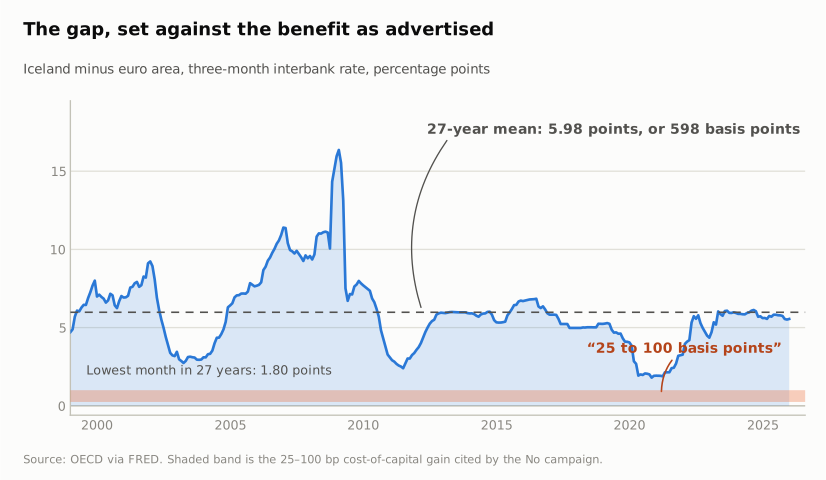
But the argument is from the wrong framing. Swapping the Króna for the Euro isn’t just subtracting one term from the spread, it’s a regime change that changes the foundations of the entire system.
If Bala wants to maintain that only 50 of the 598 nominal basis points get resolved by the Euro, then he needs to explain how, precisely, Iceland within the Eurozone would still see ~550 basis points worth of spread expressed through inflation and credit growth. I don’t see how that can happen.
What I can see, which is a real risk, is a repetition of the experience of Ireland, where low ECB rates, minus domestic inflation, led to very low interest rates in real terms, which led to a massive housing bubble. Given the housing shortage in Iceland, a small housing bubble might actually be a good thing, as long as it’s reined in before it goes too wild. Now, whether we can trust the Icelandic political class to do so is a whole other question entirely…
3. The security and windfall arguments
Bala confuses our membership of a defensive alliance, as per Iceland’s membership of NATO, with security. Yes, NATO significantly reduces the likelihood of Iceland being invaded, and greatly expands the consequences of attempting to do so. But that’s only one aspect of security.
When I said “the American security umbrella”, I was referring to a much more important thing: The Post-WW2 international maritime security guarantee. I’ve written about it before, but let me explain again.
Iceland’s prosperity is not entirely self-made. Yes, we have agency, and we have used that agency very effectively, but we have benefitted enormously from a large sequence of windfalls since independence, and they have granted us both more agency and more capacity to wield it. But everything built since 1945 – the trade, the fishing exports, the tourism, the tech sector – rests on a single foundation: the post-war American guarantee of free navigation on the world’s oceans, enforced by the largest navy in history.
That guarantee has now been de facto revoked, and not just by Trump, but also his two most recent predecessors. Obama’s pivot inward and “leading from behind” signalled that Washington no longer saw underwriting global trade as its job. Biden confirmed it by putting minimal effort into the Red Sea convoy effort (I’d also recommend reading War On the Rocks’ analysis of this). And Trump has moved explicitly to a transactional form of American power, with a zero-sum game type of thinking where noone rides for free. At the same time, the US Navy has shrunk by more than half in three decades while its mission has narrowed from protecting the global system to protecting comparatively narrow American interests.
For Iceland, whose entire material existence arrives and departs in intermodal containers, this is not a simple foreign-policy abstraction, this is an acute threat to our continued existence.
To be clear, the absence of the security guarantee doesn’t mean “no shipping”, it just means that everything becomes significantly more expensive, complicated, and dangerous. This year’s Hormuz crisis showed us the shape of the world that follows. A single chokepoint closed, and within weeks freight rates rose by 40%, war-risk insurance premiums multiplied (7-10x hike in hull loss premiums on 7 day cover, from 0.10-0.15% of replacement value to 1%!, and in many cases insurers simply refused to cover strait transits at any price), hundreds of thousands of containers were stranded, convoys were moving only under naval escort, and reopening of trade flows became dependent entirely on whether Trump, a supposed “dealmaker”, could figure out how to make a deal.
Iceland cannot build a significant navy, and NATO – an alliance for territorial defence, increasingly hostage to American domestic politics – does not and cannot guarantee commercial shipping, insurance markets, or supply chains.
The European Union doesn’t have a military or naval force, but it’s members certainly do, and they have a common collective interest in working together to solve this, by pooling their resources, building common maritime domain awareness, coordinating escorts, using economic might to leverage through sanctions, working on collective aviation security frameworks, and using the economic mass to keep sea lanes open for its members. Europe must solve this problem.
For Iceland, association with Europe in this context is not a question of identity or ideology. It’s more practical: We need shipping, and for that we need friends. Thus, the EU is the only available replacement for a the American maritime security guarantee, and the ledger of Icelandic independence should be honest about which side of that trade keeps the ships coming.
The Third Path
Bala ends his refutation by saying “I am voting for the third path, on 29 August”. The third path is in reference to my description of the EU-path and the EEA-path. I can only conclude that this means he is in favor of leaving the EEA. If that’s the case, well, that’s profoundly stupid.